





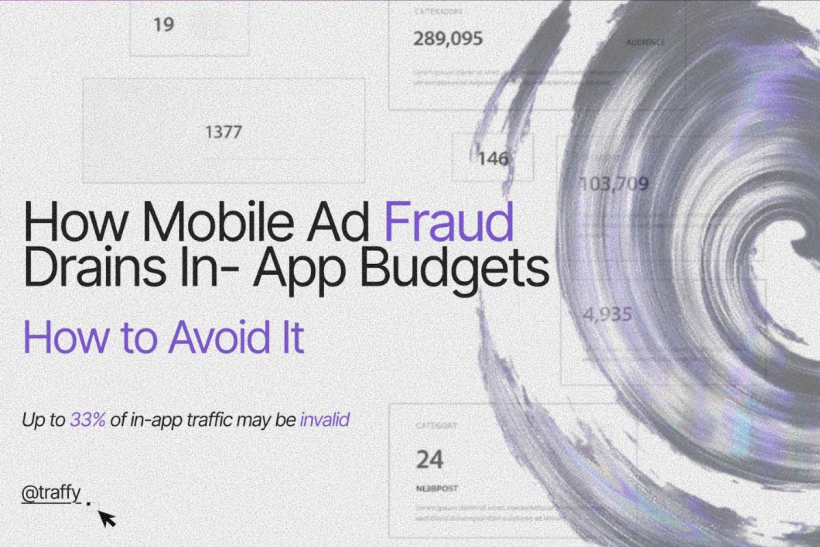
How Mobile Ad Fraud Drains In-App Budgets — and How to Avoid It

Mobile ad fraud is a hidden drain on your app marketing budget. Traffy, a performance marketing agency specializing in mobile anti-fraud, shares strategies to protect your ad spend and maximize ROI.
Most advertisers don’t lose money due to weak creatives or funnels — they lose it because a significant portion of their in-app traffic is invalid from the very start.
The Scale of the Problem
In Q3 2025, mobile apps experienced approximately 33% IVT (Invalid Traffic), meaning roughly one-third of traffic was fraudulent or invalid. Source: Pixalate — Q3 2025 Global Ad Fraud Benchmark Report.
These numbers aren’t just statistics — they reveal that a huge portion of advertising budgets is being spent not on real users, but on fake traffic, fabricated clicks, and bot-generated installs. And 33% is only an average.
Depending on the traffic source and buying model — particularly in programmatic (DSP) environments — fraud levels can vary dramatically. In some cases, IVT may be as low as 5%, while in others it can reach 50% or more where controls are weak. This means many advertisers are making campaign decisions based on data that was never real to begin with.
What IVT Really Means — And Why It’s Critical
IVT (Invalid Traffic) isn’t just “low-quality traffic.” It is traffic that can never convert into a real user or paying customer.
It includes:
- Bots and automated scripts.
- Click farms and device emulators.
- Hidden impressions and background clicks.
- Fabricated installs and in-app events.
When 33% of traffic is IVT, it means every third dollar you spend is paying for actions that will never generate revenue. Multiple industry studies show that IVT in mobile advertising frequently exceeds 20–30%, and can be significantly higher for certain platforms, GEOs, or traffic types. Fraud is not an edge case. It is a structural risk in in-app advertising.
Why Mobile Ad Fraud Is Getting Smarter
Despite widespread adoption of anti-fraud systems, fraud techniques continue to evolve. Basic bot filtering is no longer enough.
Here are the most common schemes:
- Bot Installs & Bot Activity: automated installs and simulated engagement that mimic user behavior — without real intent or retention.
- Click Injection / Click Hijacking: a fraudulent app intercepts the last click before installation and claims attribution for installs it did not generate.
- Click Spamming / Click Flooding: mass volumes of fake clicks create artificially high activity signals, increasing the probability of stealing organic installs.
- Device Farms & Real Device Spoofing: hundreds or thousands of real devices systematically generate fake installs and events, often rotating identifiers to avoid detection.
- SDK Spoofing & Postback Fraud: fraudsters simulate SDK signals and send fake install or in-app event data directly to attribution systems, making everything appear legitimate.
- In-App Event Spoofing: fabricated postbacks and engagement events appear in reports — but no real user exists behind them.
How to Avoid Wasting Your In-App Budget
Fraud prevention isn’t about paranoia. It’s about systematic verification and disciplined traffic management.
1. Use an MMP With Advanced Anti-Fraud Protection
Rely on trusted mobile measurement partners such as Adjust and AppsFlyer. Enable their built-in fraud detection tools — not just attribution tracking. Attribution without fraud protection is incomplete.
2. Analyze CTIT (Click-to-Install Time): one of the strongest fraud indicators.
- Extremely short CTIT spikes → potential click injection.
- Extremely long and uniform CTIT distributions → potential click flooding.
- Unnaturally consistent timing → possible automation.
3. CTCT (Click to Click Time): a short CTCT (<100 ms) detects script bots and click farms.
4. New Device Rate: if 90%+ of devices are ‘new’ (without history), this indicates farms that are resetting IDFA/GAID.
5. Assisted Installs: a high percentage of assists indicates organic hijacking (Click Flooding).
6. Monitor Behavioral Anomalies:
-
Retention curves: fraudsters have learned to fabricate “perfect” retention. Don’t just compare to organic — check retention alongside ROAS or purchases. Retention without revenue usually means bots.
-
Payments and Cards: bots can link payment cards and often use large volumes of virtual cards with a $0 balance to pass free trials or card verification checks. Because of this, KPIs such as “card attachment” or even “trial start” become unreliable and can create a false sense of performance. The only truly meaningful indicators in this case are the rebill rate (subscription renewal rate) and the actual payment success rate. If you see 1,000 trials but zero successful charges, that is a clear sign of fraud. If users install the app but never behave like real users at the revenue level, something is clearly wrong.
-
Event depth.
-
Session duration.
-
Purchase timing.
-
LTV distribution.
- Work Systematically With Blacklists and Whitelists
Fraud control is not just about blocking traffic. It’s about controlled scaling.
- Build placement-level blacklists.
- Identify reliable publishers and scale via whitelists.
- Continuously audit sub-publishers.
- Remove suspicious sources early.
- Infrastructure
- Datacenter IP: Installs coming from hosting provider ranges (AWS, DigitalOcean, Hetzner) = 100% block.
- Geo Mismatch: Click from India, install from the US = fraud.
How to Win Against Fraud
With up to 33% of in-app traffic being invalid, many advertisers aren’t just underperforming — they’re paying for illusions. Fraud can masquerade as growth, but the real advantage comes from knowing which traffic is real. At Traffy, we specialize in mobile anti-fraud and help advertisers ensure every dollar reaches real users. If you want a comprehensive fraud audit or guidance on safeguarding your campaigns, our team is ready to help.