







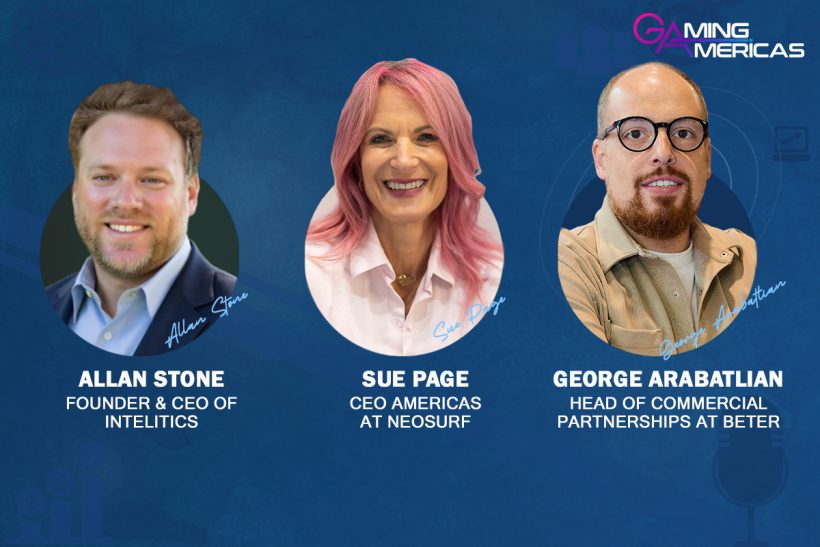

As North America prepares to host the 2026 FIFA World Cup, the spotlight is turning to what could be a defining moment for the region’s iGaming and sports betting landscape. Joining us for this roundtable are Allan Stone, Founder & CEO of Intelitics, Sue Page, CEO Americas at Neosurf, and George Arabatlian, Head of Commercial Partnerships at BETER, who share their insights on regulation, player engagement, product innovation, and the long-term impact the tournament could have on the future of betting across the continent.
With most of North America operating under fragmented or provincial regulatory frameworks, do you expect the World Cup to accelerate regulatory change or standardisation across the continent?
Allan Stone: No. Regulators don’t move on the timeline of a tournament. They move on the timeline of the next election cycle.
The World Cup will produce the political theatre that usually triggers reactive regulation. A problem gambling story. A compliance slip. A cross-border advertising incident. What it won’t produce is standardisation. The US system is designed not to standardise. State revenue interests, tribal compacts and existing operator agreements make continental harmonisation structurally impossible for the next decade.
What the tournament will accelerate is consumer expectation. A fan in Toronto who bets during the group stage, flies to Dallas for the quarter-final, and tries to use the same app, and can’t, will notice. Multiply that by a few million people across three countries over five weeks, and you get bottom-up pressure that operators have to answer, because regulators won’t.
That’s where the real shift comes from. Not legislation. Consumer dissatisfaction with fragmented product availability, inconsistent payouts, and different promo structures in every jurisdiction. The operators that engineer the best cross-border experience, inside the rules they’re given, will come out of July with a structural advantage that regulators can’t hand out and competitors can’t copy quickly.
Sue Page: This is a tricky one to answer, as there so many moving parts in North America’s provincial regulatory framework. The reality is that we likely won’t know how big an impact the World Cup will have on future change or standardisation until we actually see the successes and failures of the current fragmented legislation during the tournament itself. One thing I think we can say with almost complete confidence is that the World Cup will definitely be an eye-opener for provincial regulators, and if bettors are constantly encountering issues with their ability to use apps and wager as they travel from state-to-state and country-to-country following games, it could serve as the catalyst that informs future discussions and builds the case for more joined-up legislation.
George Arabatlian: Regulators move to their own rhythm, and a six-week tournament isn’t going to reshape frameworks that have taken years to negotiate.
What the tournament will do, however, is create the evidence base. Regulators across all three countries will watch how the industry handles this moment, especially in terms of responsible gambling measures and player protection.
Handle it well and you build the case for expansion and standardisation further down the line. Handle it badly, however, and you hand ammunition to every legislator who already has reservations.
For many North American fans, this will be their first time betting. What do operators and businesses need to do to ensure that this is as smooth as possible and create the best betting environment possible for bettors?
Allan Stone: Build for the first bet, not the hundredth.
Most betting apps in North America were designed by and for people who already know what a parlay is. The onboarding assumes the user has a mental model of odds, markets and settlement. A first-time World Cup bettor doesn’t. They want to put $10 on Argentina, understand when they get paid, and trust that the app isn’t going to do something weird with their money.
That means fewer screens before the first bet. Clearer pricing. Defaults that work without the user making fifteen decisions. Instant withdrawals to their card. In-app explanation of how the bet settles, delivered inline and contextually at the moment of friction, not buried in a glossary page nobody reads.
The operators that try to convert this audience to same-game parlays and player props on day one will lose them. The ones that let them place a simple moneyline bet, pay out fast, and then slowly widen the product surface over the tournament will convert five times more of them.
The test isn’t whether they can place a bet. It’s whether they can place a second bet without asking a friend how to do it.
Sue Page: Not to keep on banging the same drum, but the first step is to start with payments and onboarding. After that, you just need to keep the journey brutally simple. Fewer steps. Fewer failures. Faster confirmation. Faster payout. If a first-time bettor deposits successfully, places a straightforward bet, and sees winnings arrive quickly, that experience builds confidence. If they hit document requests, rejected payment methods, or withdrawal delays on day one, they may never come back. At the end of the day, the most important thing for bettors is to have a quick and hassle-free experience that works, and anything that fails to deliver that experience, whether justifiably or not, will only fuel the previously-mentioned scepticism that surrounds US iGaming.
George Arabatlian: Regulators move to their own rhythm, and a six-week tournament isn’t going to reshape frameworks that have taken years to negotiate.
What the tournament will do, however, is create the evidence base. Regulators across all three countries will watch how the industry handles this moment, especially in terms of responsible gambling measures and player protection.
Handle it well and you build the case for expansion and standardisation further down the line. Handle it badly, however, and you hand ammunition to every legislator who already has reservations.
Football (soccer) has always struggled to break into the American market in the way it has in Europe, with bettors often more focused on domestic sports. What do operators need to do to ensure continued interest in the sport after the tournament has finished?
Allan Stone: The tournament ends in July. The retention problem starts the next morning.
Most operators will acquire a soccer-led cohort in June, get one month of engagement, and then try to cross-sell them into NFL in September. That won’t work. A casual fan who bet on the World Cup isn’t a latent NFL bettor. They’re a soccer bettor, and if the product doesn’t have a soccer story after July, they churn.
The answer is a soccer content calendar that starts on day one of August. MLS is live. The Premier League kicks off mid-August. Champions League by mid-September. There’s a full year of soccer to hand this audience if operators actually build for it. Dedicated soccer CRM. Soccer-first markets on the home page for that cohort. Promo mechanics that match the rhythm of a 90-minute match, not a four-hour NFL broadcast.
The second piece is distribution. US soccer has tastemakers. Writers, podcasters, YouTubers, supporter groups with direct relationships with this audience. Most of the industry ignores them because they don’t fit the legacy sponsorship framework. Those are the partnerships that keep the cohort engaged. A three-second DraftKings ad during a Timbers match won’t do it.
Sue Page: As a Brit, lifelong Evertonian and England fan, who has lived in the US for over 20 years, the shift has been obvious. Soccer is no longer niche, but it is still event driven here rather than a weekly habit. Operators need to bridge that gap by taking World Cup engagement and connecting it to whatever comes next, MLS, Liga MX, Premier League, and European competitions etc, so that interest does not drop off after the final is over. The best route is not to push football as a copy of NFL betting, but to lean into what football does well: providing an always-on global inventory, player-based engagement, high-significance games, and the deep connection to fantasy teams.
George Arabatlian: The Final is in mid-July. MLS is mid-season, European leagues are in pre-season, and the NFL is weeks away. That window is where the football habit either forms or dies.
Operators need to plan for it now, not in June. That means a calendar of football content that fills the gap – MLS, Liga MX, Leagues Cup, plus continuous products like eFootball that keep football betting active on quieter days.
It also means using the data gathered during the tournament to personalise what gets served afterwards. If someone is betting on every Mexico match, you know something important about them, and you should be speaking to them in Liga MX terms the following week.
Betting features and products have developed significantly since the 2022 World Cup. Looking at the emergence of AI, personalisation, micro-betting and other tech/trends, what do you think will have the biggest impact on bettors this summer?
Allan Stone: Micro-betting. By a distance.
A World Cup match has a different rhythm from a four-hour NFL broadcast. Fewer stoppages, longer phases of play, a two-goal game that can swing in thirty seconds. Micro-betting fits that rhythm in a way traditional pre-match markets don’t. Next corner. Next shot on target. Next yellow card. It matches the behaviour of the casual audience this tournament attracts. Short attention, emotional engagement, constant want for the next action.
AI will matter, but it’ll matter back-office. Fraud, payments, creative optimisation, CRM personalisation, inventory buying. Consumer-facing AI products like pick optimisers and AI betting assistants still aren’t good enough to move the number, and in most cases the data latency makes them worse than useless.
Personalisation is the ceiling, not the product. It’s what lets micro-betting work for different players. A recreational bettor sees three simple micro markets. A high-velocity bettor sees fifteen. Same engine, different surfaces.
The brands that go into July without a serious micro-betting product are going to watch their engagement metrics collapse by the round of 16. This tournament isn’t about pre-match handles. It’s about what happens in the 90 minutes.
George Arabatlian: Micro-betting, by a wide margin. The fundamental shift in how younger bettors engage with content is a shift towards shorter cycles and faster feedback loops. They’re not patient with 90-minute outcome bets in the way the previous generation was. Our data from the 2024 Euros shows this clearly – the ‘Next Goal’ market on eFootball grew its share by more than 20% during the tournament.
AI and personalisation matter too, but they work best in service of that faster tempo rather than as standalone features. The winning combination is a sportsbook that understands what the individual bettor wants in the moment, serves it instantly, and settles it fast. Operators who get this right will have a product their audience still wants to use in August – and well beyond