





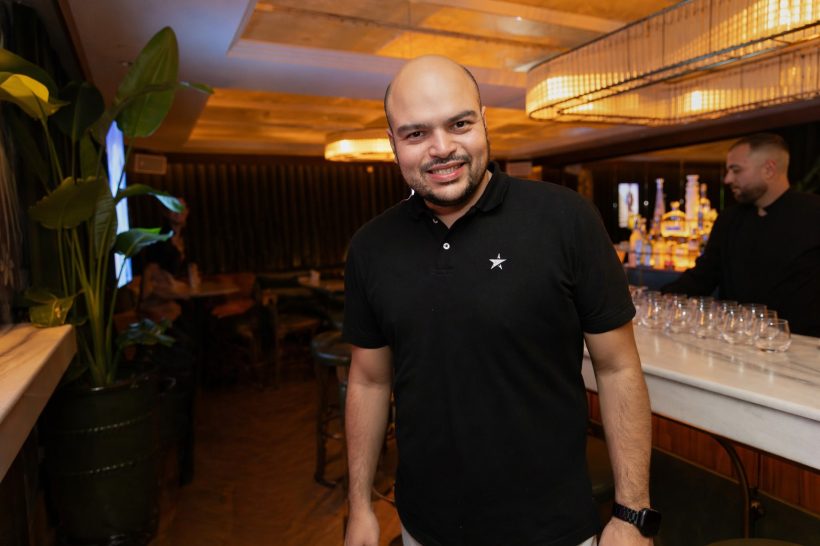

Held between April 13 and 16 in Marbella, the EGR Power 50 gathered some of the most influential voices in the global iGaming industry for a rare moment of strategic reflection and high-level exchange.
In this article, Fellipe Fraga, Chief Business Officer at Stellar Gaming, shares his firsthand perspective from the event, highlighting the key discussions shaping the sector, from the growing role of artificial intelligence to the emergence of prediction markets and the increasing complexity of regulation, while also reflecting on Brazil’s rising relevance in the global landscape.
The future in Marbella
By Fellipe Fraga
What for many is a holiday destination has, for the iGaming world, become for a few days a true laboratory of the future.
It was in Marbella, Spain, that the EGR Power 50 took place, held at the Puente Romano Resort, bringing together some of the leading global figures in the industry in an environment that combined strategic reflection, exchange of experiences, and relationship building.
More than an event, it was a pause. A rare moment in which executives, who live under daily pressure, were able to look more calmly at what lies ahead.
The meeting was not just about networking. Above all, it served as a space to discuss the sector’s recent challenges and, especially, the transformations that are already beginning to reshape the global market.
The Brazilian presence also played a relevant role in this context. Stellar Gaming, through EstrelaBet, was highlighted as one of the “six to watch” at the event, representing Brazil among a select group of global operators.
In a predominantly international environment, I was the only Brazilian executive present, which reinforces not only the company’s prominence but also the level of attention the Brazilian market has been attracting on the global stage.
As expected, topics such as artificial intelligence and prediction markets dominated much of the conversation. In the case of artificial intelligence, the discussion is no longer about “if,” but about “how.”
How can these tools be better used to gain operational efficiency?
How can teams be enhanced? And perhaps most importantly: what new products and experiences can emerge from this new technological layer?
Artificial intelligence is no longer just a support tool and is now taking on a central role in companies’ strategies.
Prediction markets, on the other hand, bring an even more sensitive debate. Are we talking about something complementary to the traditional betting model, or a new competitor? The answer, at least for now, depends on perspective.
On one side, we have the classic model, in which the operator sets the odds and assumes the risk.
On the other, an environment where the dynamic is market-driven, with prices formed through the interaction between participants.
This raises relevant questions: are we dealing with distinct products or variations within the same category?
Is the simple combination of forecasting future events and financial exposure enough to classify them under the same concept? Or are the operational structure and the role of the operator the determining factors in this distinction?
And perhaps the most important question of all: how will regulators approach this development?
If there is one thing that is clear, it is that regulation—already one of the industry’s major topics today—is likely to become even more challenging in the coming years.
Another interesting aspect of the event was the mastermind sessions. In these more closed discussions, away from the stages, candid conversations emerged about day-to-day operations, strategic decisions, and even mistakes made along the way.
This type of exchange, often more honest and less institutional, is what truly accelerates the development of the sector. And, of course, there is also the human side.
Between a round of golf and a wine tasting, the event reinforced something that, at the end of the day, remains central: this is an industry made up of people.
For that reason, getting to know who is on the other side of the table, building trust, and strengthening relationships remains just as important as any technological innovation.
Perhaps this is the greatest value of gatherings such as the EGR Power 50.
In a sector that is growing rapidly, constantly transforming, and operating under regulatory and competitive pressure, taking time to collectively reflect on the future is not only useful, but necessary.
Because, in the end, the future of iGaming will not be defined solely by technology or regulation, but by the ability of its leaders to interpret change, make decisions, and, above all, act before others.
Fellipe Fraga is Chief Business Officer (CBO) – responsible for Institutional Relations at Stellar Gaming.
Holds a law degree from PUC Minas, with a specialization in Public Law from UNESA, and has extensive experience in Public, Electoral, and International Law. He was a founding member of the Superior Court of Sports Justice for American Football (STJD-FA) and served on the Sports Law Commission of the Brazilian Bar Association (OAB-MG).